Master Thesis
Final Thesis for the Master’s Degree in Computer Science and Engineering at Politecnico di Milano, developed in 2022 at AirLAB under the supervision of Andrea Bonarini and Federico Espositi.
Social robotics aims to create autonomous robotic companions assisting humans both in work and leisure time, whose interaction mechanisms highly resemble those employed in interpersonal communication. Such goal is however far from being achieved, and no robot has been yet developed able to interact with humans in unconstrained settings.
In this context the art of theatre can come into help, as an ideal workshop where to develop, in a controlled environment, the social aspects of the interaction. Several works in human-robot interaction have in fact adopted theatre as a training field, motivated by its ability to simulate reality and replicate structures of human communication.
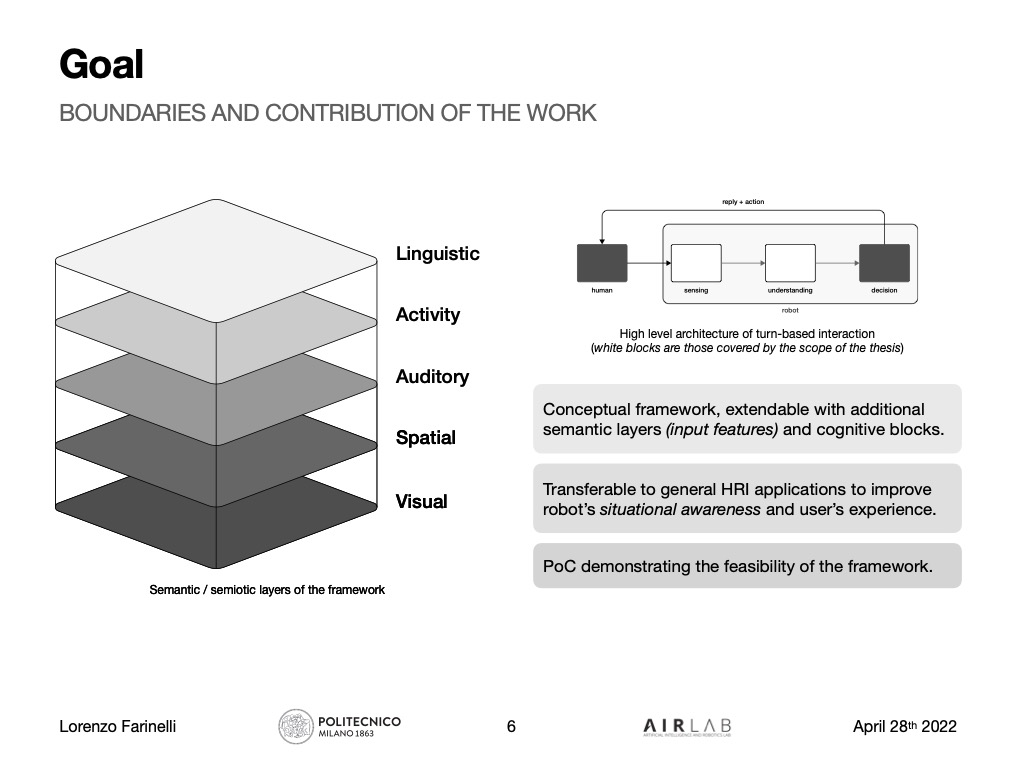
The work developed here follows this tradition as well, giving its contribution to novel forms of improvisation between human actors and robots. What is going to be proposed is in particular a framework to render an autonomous robot able to perceive the emotional state and intentions of the actor, detecting the scenic actions they perform on stage.
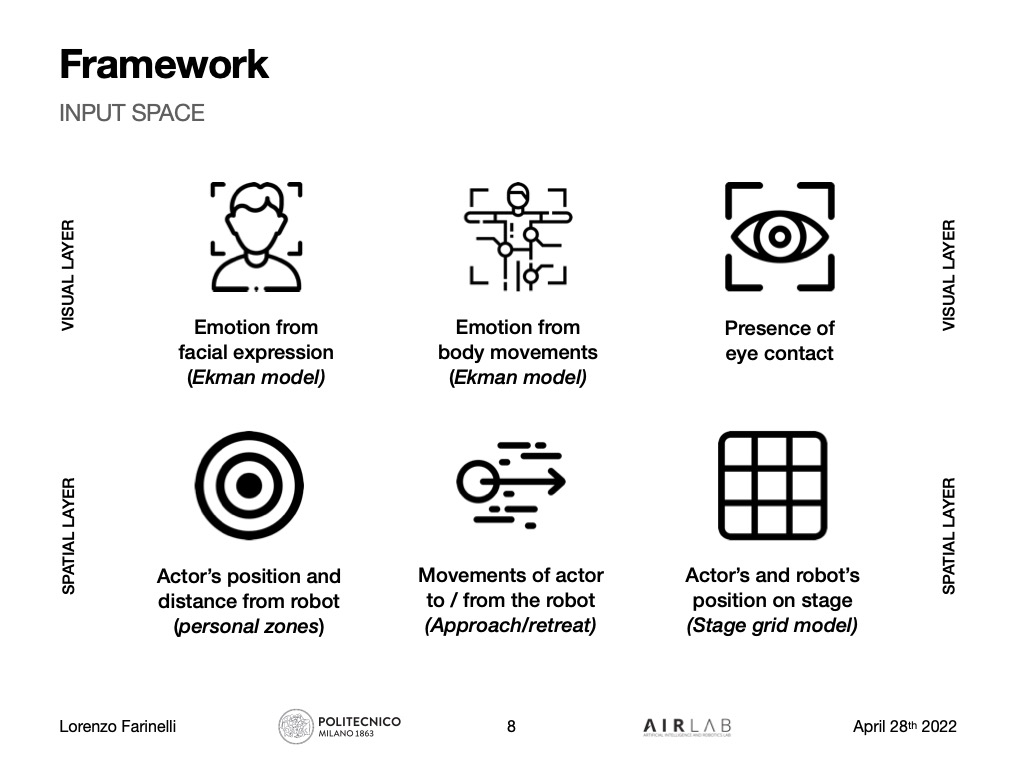
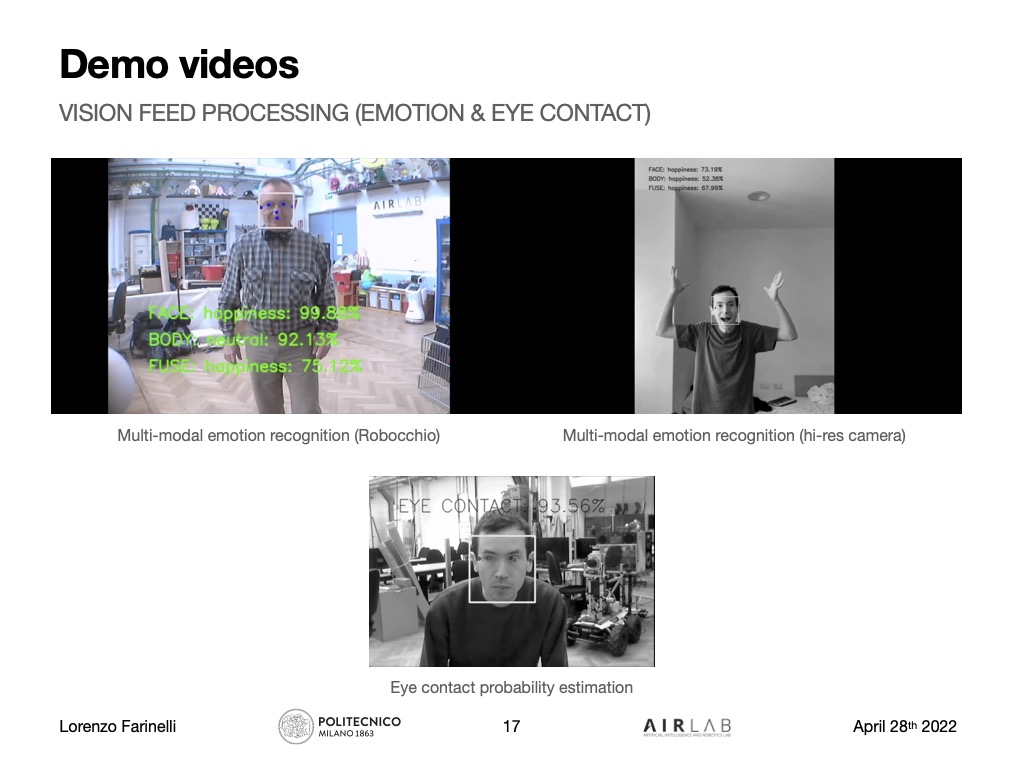
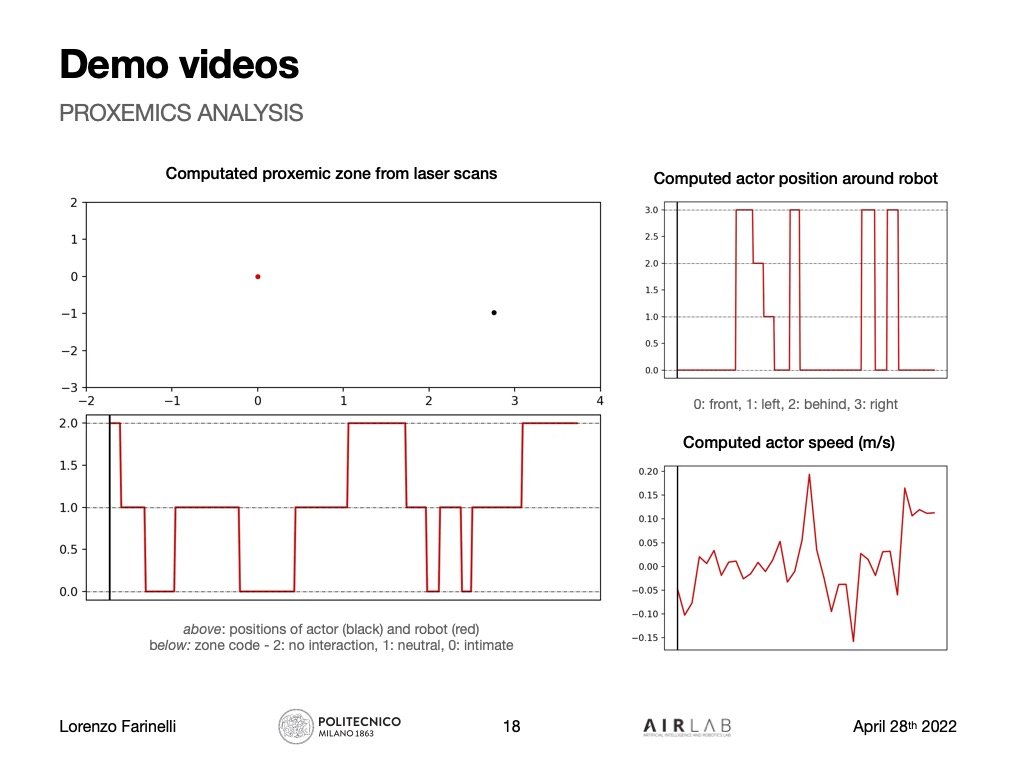
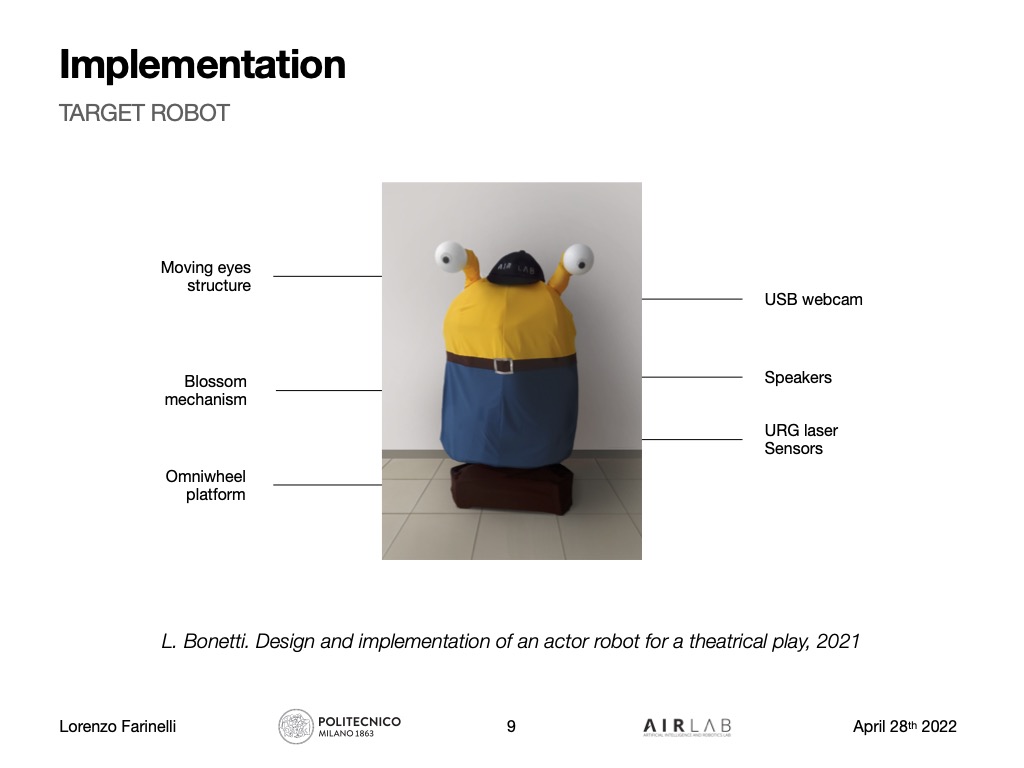
Based on theories from neuroscience, psychology, acting and choreography, the framework acquires, processes and analyses in real-time several features of the actor’s performance, through a set of sensors mounted on the robot and computational algorithms.
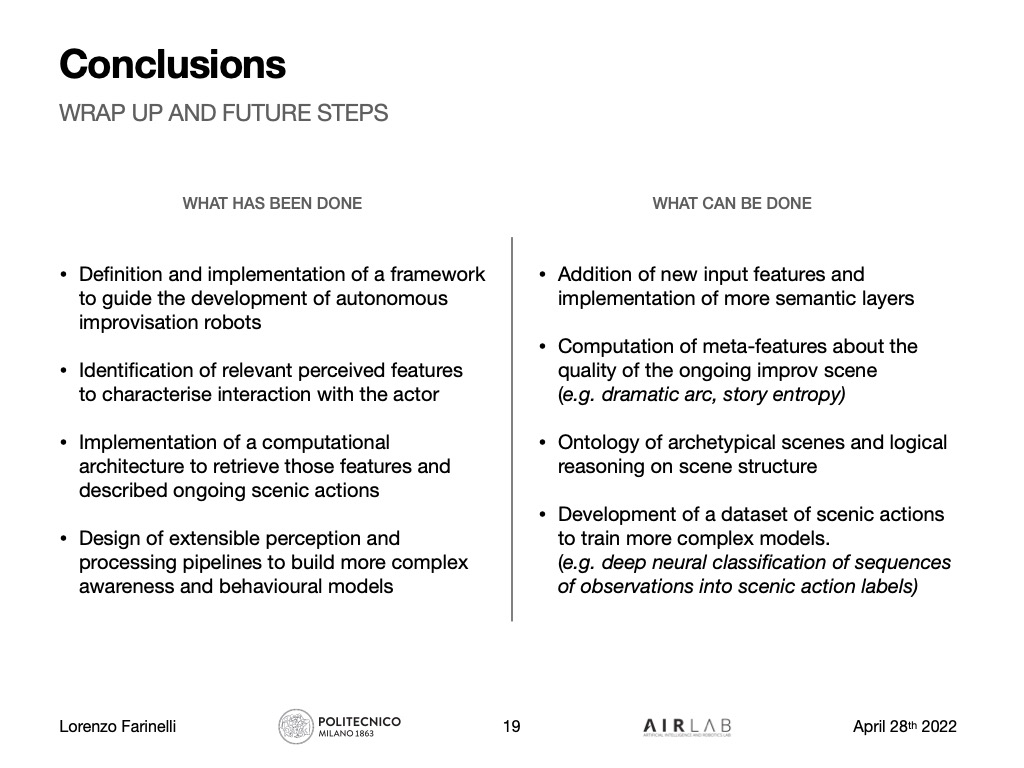
From collected features a classification into a discrete set of basic performative actions is derived, which timely characterises the actor’s attitude and intentions. This output can be subsequently attached as an input to third-party systems, to produce for instance a physical reply. In this way it will be possible to design cognitive pipelines of diverse complexity, adding modules related to the robot’s psychology, mobility and aesthetics.
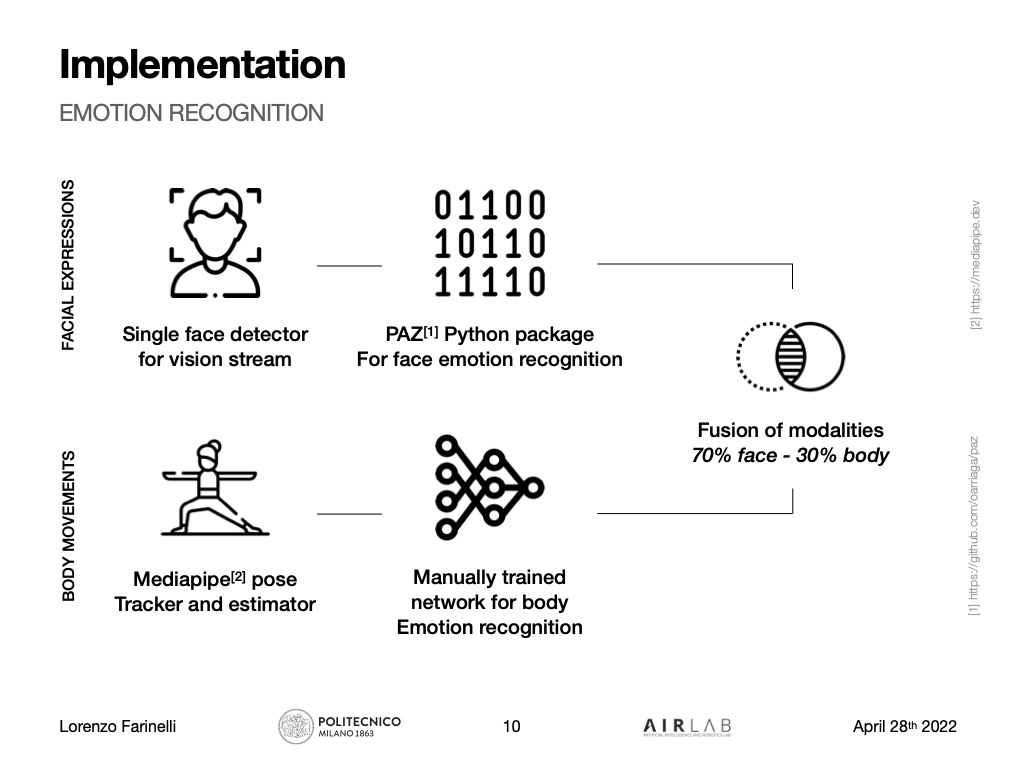
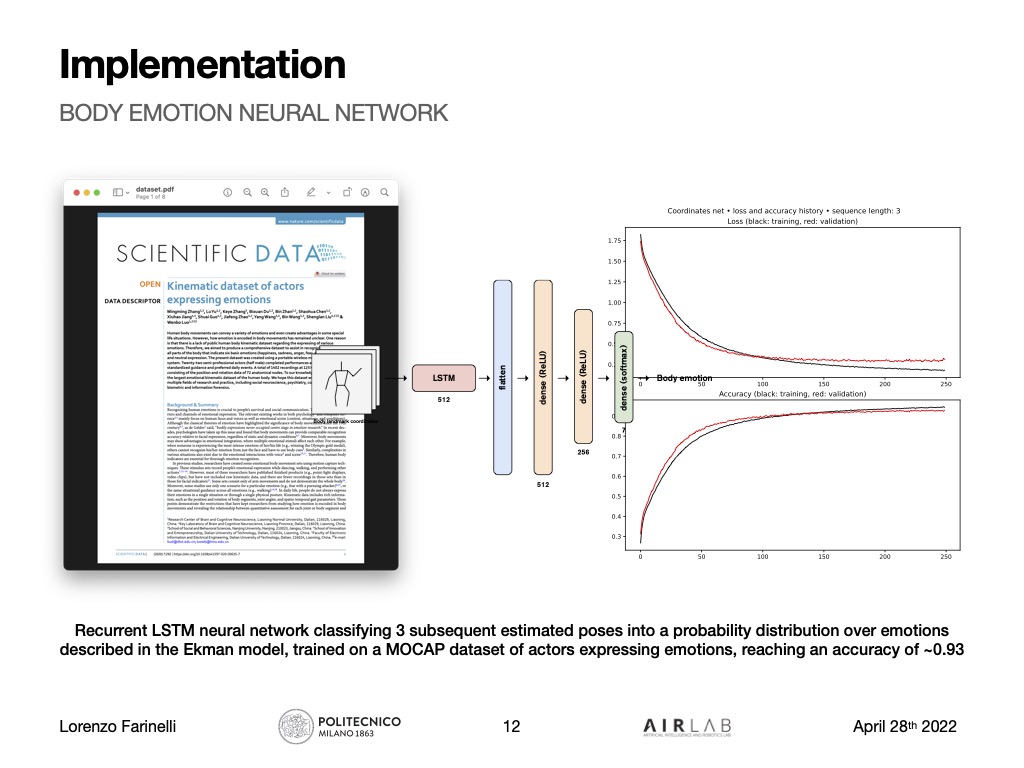
To ensure a functional and optimal behaviour, the implemented system has been designed using a mixture of both third-party open-source state-of-the-art algorithms and manually trained neural networks, choosing among the available solutions on the basis of several trade-offs.
Full text of the thesis is available here, while a shorter executive summary is available here.
Below, the most relevant slides from the thesis defense presentation are reported.